Wednesday, March 18, 2015

Constitution on the Sacred Liturgy


The Constitution on the Sacred Liturgy was the first document promulgated by the Second Vatican Council, and was the cause of great excitement where I was living.  We had been very involved in the liturgical movement, and this document promised to fulfill all of our hopes.

First of all, the language is not just juridical.  The liturgy, it says, “is the summit toward which the activity of the Church is directed; … it is the fountain from which all her power flows” (SC 10).  The liturgy is not just an obligation to be fulfilled every Sunday; it is a love affair:  “The renewal in the Eucharist of the covenant between the Lord and man draws the faithful into the compelling love of Christ and sets them afire” (10).

The reform of the liturgy is not just for priests.   “Mother Church earnestly desires that all the faithful be led to that full conscious and active participation in liturgical celebrations which is demanded by the very nature of the liturgy” (14).  But if this is to happen, the liturgical instruction of the clergy is essential.  

The changes to be made in the liturgical rites must be based on theological, historical and pastoral study, and the role of sacred Scripture should be emphasized.  “The rites should be distinguished by a noble simplicity; they should be short, clear, and unencumbered by useless repetitions; they should be within the people’s powers of comprehension, and normally should not require much explanation”(34)

.Another big thing was that homilies should be based on scripture.  “If the restoration, progress, and adaptation of the sacred liturgy are to be achieved, it is necessary to promote that warm and living love for Scripture to which the venerable tradition of both Eastern and Western rites give testimony” (24).

We waited eagerly for English translations to come out.  One thing we had not realized was the effect the changes would have on the music.  We had been well trained in Gregorian chant, and loved its prayerful simplicity. The Council had not thought too much about that either (116-117). The English music which replaced it left a lot to be desired.  That, to us, seemed to be the chief downside to the liturgical renewal.  

Bernard Cooke and Gary Macy’s Christian Symbol and Ritual tries to help a general audience understand the meanings of symbol and ritual so that it can understand their meaning in the Catholic Church.  I have to confess that I did not enjoy this book.  In trying to make things simple, it seemed to me that it made their discussion more complicated, and their attempts at humor were more annoying to me than funny.  

However, I did appreciate their treatment of the relationship between symbols/rituals and power.  I’d never heard of royalty in the Middle Ages being treated as ordained clergy, although it is true that they had much power in the church. Maybe that was a case of the polyvalence of symbols. (Cooke and Macy 22-23).

Another point that they brought out which I had never reflected on before was that “Real rituals are never generic, never repeatable, and never exist in books” (24).  They also spoke of rituals for death and dying as helping a person on their way to heaven and “to comfort and reassure the living” (31).  Another important aspect of funeral rituals can be to re-establish the power structure within the group so that it can carry on.

In terms of my ministry in the prison, we talked about preparing a ritual of reconciliation to celebrate during Holy Week.  They broke up into groups yesterday to begin planning it, to choose scripture readings, songs, prayers, and ritual actions they want to include.  They were very pleased at the idea.  I’m looking forward to seeing what they come up with.

Tuesday, March 17, 2015

Lawyer


Lawyer’s Blog:
Week 11
Solely reading the title of SACROSANCTUM CONCILIUM as it pertains to the religious concept of liturgy generated an expectation in me to look forward to reading further into the text of the writing. It seemed to as if I was entering a level of knowledge on the subject of the liturgy which was very new to me and helpful in revealing a broad scope of the liturgical concept. Once I got past the preliminary paragraphs which somewhat connects the subject matter of liturgy to the divine purpose of God and salvation provided through Jesus Christ, I began to find the writer’s approach to be overreaching and lacking the simplicity for making the connection more easily comprehensible for the reader. This seemed to set the tone for the remainder of the text.
As I read on into para.6, it appears as if the writer does in fact define the idea of liturgical life as a way of fulfilling and or a product of salvation. I am okay with this approach to the attempt to define the concept of liturgy; however, I again begin to lose sight of subject matter when the writer immediately delves into the idea of the paschal mystery of Christ. I value the paschal mystery of Christ, but if prefer clarity in the exposition of the topic of liturgy. At this point of the writing, I do not get what I am looking for. As I continued reading this became somewhat of pattern, and although I relish the obvious depth of thought in the quality of the overall content of the writing, nevertheless, I believe its effectiveness was diminished in the mind of the common man due to the failure to relate the message with more practicality.

How do we Understand Ritual?


In today’s secular world, rituals are another fancier word we use to describe parts of our daily routine. Cooke and Macy write about how part of our daily experiences of growing up become part of a ritual of sorts, everything from the time of day we eat and what we wear to our relationships with our family such as daily meals and conversations. We develop and continue to change and adapt our rituals as they fit our current state of life (Cooke and Macy 25-26). Why do we eat at certain times? Why is it that we went to formal education, go to college, and then get a job? Perhaps it could be part of our culture, or our growing up (Cooke and Macy 26). As we grow older, we begin to question our beliefs and our routines we have; when we become adults and/or have our own families, we can decide in a way some of the rituals we want for our family to be the same and what to change.

There are also special ceremonial rituals, including graduations, fraternity initiations, and debutantes. There are Sacramental religious ceremonies: Baptism, Eucharist, Confirmation, Holy Orders, and Matrimony. Cooke and Macy stated that the point of marriage was union of two families and hope that their offspring would carry on family legacy. It’s interesting they wrote that while in some cases the couple could grow to love one another, that was not usually a goal (Cooke and Macy 28). This reminds me of the arranged marriages of old, royal families. Perhaps that’s why much of the royalty – even many “Religious” ones! – had affairs. Cooke and Macy write that Marriage we know is really part of close friendship – the kinship of two people who mutually admire, respect, and love one another. Over time, the idea of marriage and friendship would merge in the Christians’ eyes. Christians understood “that friendship and love is not simply fundamental to a marriage but even as a powerful symbol of the deep friendship and love that exists between God and humans” (Cooke and Macy 29). I remember teaching my students how Covenant of Marriage was between a couple who freely and knowingly entered into a union of love between themselves and God. In this Covenant they were to be faithful and exclusive, and also open to children, the ultimate gift of God’s love from the couple.

I also read that the word, Sacramentum, is different from what we assume to be Sacrament. It’s fascinating that in history, Sacramentum was referred to as specific examples such as the water in Baptism and the Bread and Wine in Eucharist. Baptism and Eucharist are the Sacraments we know; however, they are not the Sacraments that would have been translated by St. Thomas Aquinas. Instead, these “Sacraments” as known by Aquinas are really what we know as the Rituals of the Baptism and Eucharist (Cooke and Macy 37-38). We need the water in Baptism because part of that Ritual is pouring the water on the person’s head. The Bread and the Wine of course become consecrated into the Body and Blood of Christ during the Eucharistic Prayer. Without these Rituals, the Sacraments we know would not be possible. Many Rituals still accompany Christians today – as they are part of the symbolic impact of Jesus Christ from His birth – the Nativity Story in Advent and Christmas – to His death, Passion and Resurrection during Lent and Easter (Cooke and Macy 39). These Rituals help us understand our role as Catholics and Christians in the world, as well as help us understand the Ministry of Christ. Without these Rituals – and our daily Rituals – our life would not be ordered. God has instilled these rituals to order us – from when we wake up to what we wear to when we go to Mass and pray and love and serve God. For that, I am thankful for Rituals.


Liturgy, Symbol and Ritual


The conversation of symbols with cloth and paint is the mark of expression from me to others. I have often claimed to be a self-taught fiber artist. But, really, my instructor has been God who has planted in me the gifts of desire, curiosity and ability to use His designs in nature, humanity’s appropriation of fibers grown from the Earth’s soil, with the addition of sunlight and water, so many who have shared their gifts of talent and time expressed in classes, books and magazines, and many art mediums displayed in numerous venues, indoor and outside.

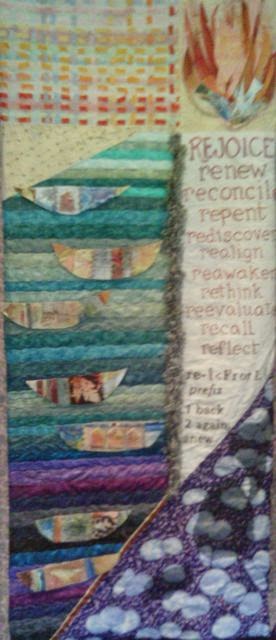
I have opened my posting with a picture of the Lenten art quilt presently displayed in St. Ignatius Chapel on Loyola’s campus. It is one in a series of Liturgical arts cloths placed during the year in the Chapel. They were created in collaboration with a traditional artist in my faith community. Recognizing the particular “seasons” of the Liturgical year is part of the Christian rituals expressed in the change of colors, vestments, and readings of the liturgies in churches that return year to year to the cycle of the waiting for the Messiah now and at the second coming – the end time.

As noted by Cooke and Macy, “rituals aid interaction” (4). In this case, the art cloths invite those praying during a liturgy or a visit to the Chapel to enter a scene of travel or journey, “to choose a skiff and travel to the Easter shore;” a “shared experience” of “insiders” discussed by Cooke and Macy (11, 35), here, of Christians who recognize hope, transformation and renewal during Lent in preparation for Easter, a celebration of our salvation through Jesus (49).

Of course, if the art cloth were placed in a secular environment or viewed by one without knowledge of Lent and Easter, the viewer may simply enjoy or just see boats on water, a flame, and words that begin with “re-.“ And that is fine, too. My goal is to not hit someone over the head with meaning, but to provide comfort, inspiration and interest in something different and new. Each of us comes to a ritual or symbol from a unique perspective. While we may share a Judeo- Christian or Catholic background, where we are in our lives probably shapes what we are seeking or accepting from a ritual or symbol. In this way, “perceptions and understandings of reality shape human reality,” and, perhaps, “symbols actually shape our reality,” as suggested by Susanne Langer, the American philosopher (Cooke and Macy, 7). It is in our growth as maturing Christians we may choose to use our freedom to accept God’s wisdom through our “belief in the power of” the Holy Spirit and reject evil in our world and “join together and support one another as [we] work to bring justice and peace into the world” (49).


The readings this week were so helpful in putting into words what the liturgical practices of the Catholic Church mean in my spiritual life.   In Flannery’s book, “Vatican Council II," Sacrosanctum Concilium declares,"the liturgy is the summit toward which the activity of the church is directed; it is also the source from which all power flows" (122).  From the Eucharist "grace is poured forth upon us as from a fountain" (122).

The church's liturgical year is especially important to me in my faith walk.  The different seasons of the liturgical year call to me in different ways, through the different focuses of each season or celebration. Each celebration calls me to look inward as I strive to unite myself to Christ and to follow in his ways,  "The church completes the formation of the faithful by means of pious practices for soul and body, by instruction, prayer, and works of penance and mercy" (150).

I had never really thought about it before, but in reading SancrosanctumConcilium, I gained a greater appreciation of how this church document oversees all of the elements and details of worship, from the music to the art work.  The texts intended to be sung "should be drawn chiefly from the sacred scripture and from liturgical sources" (155).  As we sing, we are learning scripture and it is settling into our minds and hearts.  This document encourages the attitude of musical communal worship - “religious singing by the faithful is to be skillfully encouraged,” so that the “voices of the faithful may be heard” (154). 

The beauty of the stained glass windows, the scenes depicted in the Stations of the Cross, Jesus hanging on the cross above the altar, the Real Presence residing in the tabernacle, the smell of incense, the feel of the wood on the pew as I kneel and pray, all create an atmosphere that directs my thoughts and draws my heart to the Divine.   As the document states, “all things set apart for use in divine worship should be worthy, becoming, and beautiful” (156).  It is such a welcoming atmosphere that even a few of my directees who are not Roman Catholic go to sit and pray inside catholic churches.  Like me, they find the beauty of the surroundings and a sense of the Holy Spirit’s presence very conducive to conversation with God and holy listening.  

Rituals
In the Introduction of Christian Symbol and Ritual Cooke and Macy ask us to look at the rituals we have incorporated into our daily lives that help structure our day. Two opposing rituals sprang to mind.  The first is my daily quiet time in my sunroom at sun rise.  It is here that I greet God in my day.  I sit, read, pray, ponder, journal, write letters and wait for God to show me all of His beauty through the wonder of creation.  The sun peeks through the trees in purples that change to pinks and peach, the birds visit the feeder, cats, dogs, flowers, butterflies all wander in and out of my view much like the Discovery Channel or Nat Geo only this is my reality and I feel sanctified by it.  It is the epitome of grace. It is my favorite time of day and the time in which I am most present to God.   The second ritual that sprang to mind was this weekend’s arrangement for my husband and I to meet the parents of my daughter’s boyfriend.  This is a first in our family and I was feeling nervous and anxious.  I couldn’t help but think how in days gone by this ritual may have involved us offering goats and sheep for our daughter rather than sharing a friendly meal over pizza as we broke through the awkwardness and began to learn about one another.  Both are rituals and serve a purpose yet each are experienced very differently.  The latter experience functioned to bring two families together and initiated the beginning of a relationship between the two families. It was for the most part a practical, social endeavor.  The first ritual, the sunroom ritual, embodies what Hugh St. Victor described as sacramentum. “Anything at all that mediates the divine presence to humans would be a sacramentum.”(37)   Later Cooke and Macy say that a sacrament meant any symbol or ritual that God chose to mediate salvation to humans. (38).  This changes the definition a bit in that my sunroom ritual, I think, sanctifies  but does not necessarily mediate salvation.  If a Christian ritual or sacrament has  the sole purpose of salvation, then that implies more of a church ritual with Jesus as the symbol of salvation.  I think we need many rituals.  Some that are individual and bless us in our journey with the Creator, and some, for us Christians, that mark the paschal sacrifice which brings salvation.


One other idea that really struck me and comforted me  is the discussion of grace (50).  “The proper response to grace is thanks, not guilt. Guilt still implies that some how people ought to deserve grace. The point of grace is that it’s free, undeserved and wonderful”.  This  is the true gift of Jesus’ sacrifice.  That beyond our human striving and faults, we are given the ultimate gift of being beloved and are offered salvation.  Can a ritual give us salvation?  In and of itself, it cannot but it can remind us of this gift and give us the opportunity to accept the love of the Creator and through his Son receive salvation.

I think that spiritual direction would be an opportunity for people to examine the meanings of their own rituals and how they do or do not bring them closer to God.